
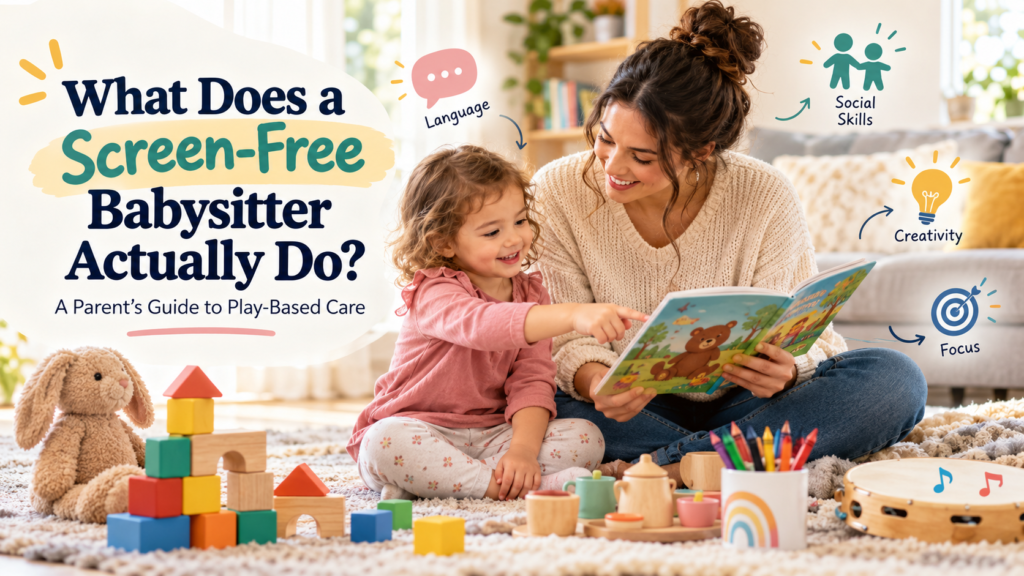
A screen-free babysitter replaces passive screen time with guided, hands-on play such as stories, music, building, sensory games and pretend play, matched to your child’s age. The goal is that every hour of care also builds language, social skills, focus and emotional confidence.
What Is Screen-Free Babysitting?
Screen-free babysitting means your child’s time with a caregiver is filled with real-world interaction instead of tablets, phones or TV. The sitter does not simply stand guard. She sits on the floor, talks, sings, builds, pretends and responds to your child’s cues.
It is different from simply “no screens allowed.” A sitter who only says no, without offering anything in its place, leaves a child bored and fretful. The skill lies in the replacement: a rich menu of activities that hold a child’s attention for real.
Why Does Screen-Free Care Matter for Young Children?
Young children learn through their senses, their bodies and, above all, other people. Back-and-forth interaction, where an adult talks, the child responds and the adult responds again, is one of the strongest drivers of early language growth. A screen cannot respond to your child’s particular babble, gesture or mood the way a person can.
Health bodies agree that the earliest years need the most protection from screens. The World Health Organization advises no sedentary screen time for children under one and no more than an hour a day for ages two to four, with less being better.
Practical reasons parents notice at home:
- Calmer evenings. Children who have played actively tend to settle more easily at bedtime.
- Longer attention spans. Building, drawing and storytelling train focus in ways fast-cutting videos do not.
- More words. Children who are talked to, not talked at, pick up vocabulary faster.
- Better mood regulation. Real play includes small frustrations, such as a tower that falls, and children learn to cope with them.
How Does Play Build Skills? Four Areas to Know
1. Social skills
Even a one-on-one session teaches turn-taking, patience and listening. A good sitter also arranges simple group play, such as a neighbourhood playdate or a sibling game, so children practise sharing and resolving small disagreements.
2. Emotional understanding
Pretend play lets children rehearse feelings safely. When a teddy bear is “scared of the doctor,” the child learns to name fear and offer comfort. Sitters can gently label emotions in the moment: “You look frustrated. Shall we try again?”
3. Language and listening
Reading aloud, rhymes, songs and “what do you think happens next?” questions build vocabulary, comprehension and confidence in speaking.
4. Thinking and problem-solving
Blocks, puzzles, sorting games and kitchen-table experiments teach cause and effect, patterns, counting and creative planning.
Screen-Free Activities by Age
| Age | Activity ideas | Skill it builds |
|---|---|---|
| 0 to 12 months | Tummy-time play, soft rattles, mirror games, lullabies, peek-a-boo | Motor control, bonding, early listening |
| 1 to 2 years | Stacking cups, water-and-sponge play, picture books, clapping songs | Hand-eye coordination, first words |
| 2 to 4 years | Pretend kitchen, play-dough, finger painting, simple puzzles, dress-up | Imagination, vocabulary, fine motor skills |
| 4 to 6 years | Storytelling, board games, treasure hunts, craft projects, helping cook | Turn-taking, planning, patience, focus |
| 6 years and above | Homework help with breaks, chess or ludo, science experiments, drawing comics, outdoor games | Reasoning, resilience, teamwork |
What Does a Play-Based Babysitting Session Look Like?
Here is a sample rhythm for a toddler. A real session flexes around your child’s mood and nap schedule.
- Arrival and warm-up: Greeting, a short chat and a gentle first activity such as a picture book.
- Active play: Music, dancing or a movement game to burn energy.
- Quiet creative time: Drawing, play-dough or sensory trays.
- Meals and rest: Feeding and nap routines followed exactly as you set them.
- Story and wind-down: Calm reading or singing before the next stretch of the day.
A sitter should also pass on a short summary at handover: what your child ate, how they slept, which new word or skill appeared.
How Kacher Lok Supports Screen-Free Childcare
Kacher Lok provides verified, experienced home caregivers in Kolkata, with a replacement policy if the match is not right. Our baby sitter service in Kolkata focuses on attentive, hands-on engagement for infants, toddlers and school-age children.
Families with other needs can explore related care too:
- New born care and Japa service in Kolkata for the first weeks and months with a baby
- House maid services in Kolkata to free up your own time for family
- Aya service in Kolkata for dependable day-to-day caregiving help
- Elderly care in Kolkata if grandparents need support at home as well
Please note that our minimum service duration starts from 10 hours, in line with our service policy. To check availability, contact our team or browse more guides on the Kacher Lok blog.
Frequently Asked Questions
What is a screen-free babysitter?
A screen-free babysitter is a caregiver who engages your child through play, stories, music, crafts and conversation instead of TV, phones or tablets.
Is it realistic to avoid screens completely?
For most families the goal is not zero screens forever, but protecting caregiving time for real interaction, especially for children under two. Agree on a clear rule with your sitter, such as a short video call with grandparents being fine.
What can a babysitter do with a toddler all day without a screen?
Rotate short activities: songs, picture books, sensory play, building, pretend play, a walk in the building compound or park, then rest. Toddlers need change every 10 to 20 minutes.
How do I tell if my child is bored or overstimulated?
Bored children wander and whine; overstimulated children get clingy, rub their eyes or melt down. A good sitter reads these cues and switches between active and quiet play.
How do I tell my sitter about my screen rules?
Share them in writing on day one, including what is allowed (for example, calls with family), what is not, and what to do instead when your child asks for a screen.
Does Kacher Lok offer hourly babysitting?
No. Kacher Lok’s minimum service duration begins at 10 hours, or as per the current service policy.